
At the start of my science communication career, the very first thing I published was a short reflection on the similarities between science and poetry, and how we can use the latter to communicate science. It was also the first piece of work I created under the mentorship of Olle Bergman. During this time, he told me about Sam Illingworth – a professor, science communicator, and believer in using poetry to disseminate scientific ideas – and I knew I had to someday complete the circle by interviewing Sam for my blog. I finally made it happen, and I am proud to share this insightful conversation with Sam with all of you.
Sam is a professor of creative pedagogies at Edinburgh Napier University, and currently, his research involves using poetry and games to create dialogue between audiences. Sam is also the founder of Consilience, a first-of-its-kind, peer-reviewed science and poetry journal.
In this interview, Sam tells me about his journey into science communication, how he engages different media to invite interactions with science, and the importance of tailoring messages to connect to different audiences.
Tell me a little bit about yourself and how science communication became a career choice for you.

I started out as an atmospheric physicist, measuring greenhouse gases using satellites and aircraft. But during my PhD, I realised I was more interested in how science connects with people than in the data itself. I became fascinated by the gaps between scientists and wider society and wanted to find ways to bridge them.
That curiosity led me to Japan, where
I studied the relationship between science and theatre, and then to a lectureship in science communication. Since then, I have used poetry, games, and other creative tools to help make science more accessible and more open to dialogue. Science communication was never a career I set out to do, but it became the only one that made sense.
You founded the Consilience journal, the world’s first peer-reviewed science & poetry journal. What inspired you to create it, and what do you want people to take away from it?
Consilience came from a desire to create a space where poetry and science could meet on equal footing. Too often, they are treated as separate worlds, but to me, they are just different ways of asking questions about how we live and what matters.
I wanted to build something that not only published science poetry but also treated it with the same care and respect we give to scientific research. That is why we use peer review, not to gatekeep but to support and improve. The goal is to help people feel part of a community where feedback is generous and learning is collective.
What I hope people take away from Consilience is that science and poetry are not opposites. They are complementary tools for making sense of the world. And that everyone, regardless of background or training, has something valuable to contribute.
Your current research involves using poetry and games to create meaningful dialogue between different audiences. What does meaningful dialogue look like, and what does it entail?
Meaningful dialogue is less about agreement and more about recognition. It is about listening to understand, not just to reply. When I talk about dialogue in science communication, I mean creating spaces where people feel heard, respected, and able to shape the conversation.
In practice, that often means moving away from traditional top-down models. Instead of scientists delivering information, we work with communities to co-create something together, like a poem or a game. These creative tools help flatten hierarchies. A poem written together invites shared vulnerability. A game opens up space for negotiation, for choice, for play.
Meaningful dialogue is also about letting go of the need to have all the answers. It is about making room for uncertainty, for emotion, and for different ways of knowing. When that happens, science becomes less about telling and more about asking. And that changes everything.
Books, podcasts, and games are all media you have used in your work and research in science communication. How do you tailor your messaging to each of these audiences and their needs?
Each medium offers a different kind of conversation. With books, I have the space to go deep, to build an argument slowly, and to invite the reader into a more reflective space. A book allows me to bring together research, personal stories, and practical advice in a way that feels grounded.
The podcast is more immediate. It is about tone, rhythm, and intimacy. When I read a science poem aloud, I want the listener to feel something before they even think about it. It is about drawing people in through sound, then giving them space to reflect on the science behind the words.
Games are different again. They are not about delivering a message but about letting people explore systems, make decisions and experience consequences. The message is not what I say, it is what players discover through play. So, when I make a game, I try to create a space where people can bring their own questions and values into the experience.
In all cases, it is about respect. Respect for the audience’s time, intelligence and lived experience. I do not assume what they need. I try to listen, adapt and build something that invites curiosity rather than insists on a conclusion.
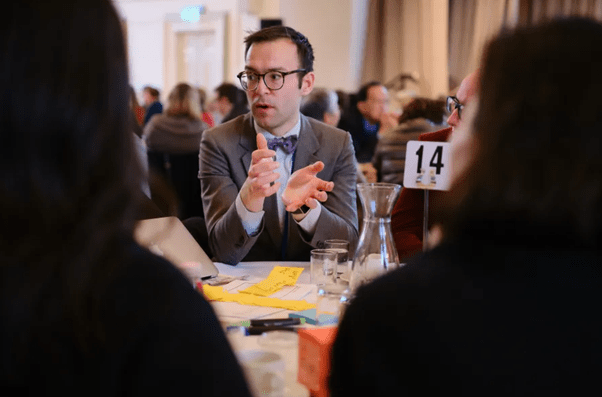
Why do you think tailoring the message to fit each audience is important in science communication?
If you are not speaking in a way your audience can connect with, then the message does not land, no matter how accurate or well-intentioned it might be.
Different audiences bring different experiences, expectations and needs. Tailoring the message means meeting people where they are, not where you think they should be. It also means respecting their knowledge and avoiding assumptions. You cannot use the same language for a policymaker, a school pupil and a community group and expect it to resonate equally.
Tailoring is not about simplifying or dumbing down. It is about relevance, empathy and clarity. It is about building a bridge that people want to walk across, rather than one that just shows off the architect’s skills.
Tailoring [your message] is not about simplifying or dumbing down…it is about building a bridge that people want to walk across, rather than one that just shows off the
Sam Illingworth
architect’s skills.
What role do you see your work across all these media/platforms play in (the greater) public engagement with science?
I see my work as helping to open up different entry points into science. Not everyone wants to read a journal article, and not everyone feels comfortable asking a question at a public lecture. But a poem, a game, a blog post, a podcast are all media that can offer gentler invitations.
The aim is not to replace traditional science communication but to extend it. To show that science can be emotional, playful, messy and human. It is not only about answers, but about questions worth sitting with.
Across all these platforms, I try to create space for dialogue, for curiosity, and for other voices to come in. If my work helps someone feel that science is something they can connect with on their own terms, then it is doing its job. Public engagement is not about broadcasting; it is about building relationships.
You have also worked in the education space with students, to communicate science and to understand their attitudes towards science. Over time, have you noticed a change in children’s/students’ interest in science? What about their parents?
I have worked with a range of age groups, from primary school children through to university students and adult learners. That said, most of my work with younger audiences was earlier in my science communication career. These days, my focus is more on higher education, particularly on how students engage with science and creativity within academic settings.
Because I no longer work closely with school groups, I would not feel confident making broad claims about shifts in children’s or parents’ attitudes to science over time. What I can say is that when I did work in schools, curiosity was never lacking. The challenge was often about confidence, i.e., helping students feel like science was something they could ask questions about without needing to get everything right.
With parents, I have had less direct interaction, but I imagine similar dynamics apply. People engage most when they feel invited in rather than judged from a distance. Whether it is students or parents, I think the more we focus on listening and co-creating, the more meaningful that engagement becomes.
Learn more about Sam and his science communication work here, and read the latest edition of the Consilience Journal here.
 Ushashi Basu