Review: Violeta

Earlier this year, I read A Long Petal of The Sea by Isabel Allende and I was convinced that it would be the best book I read this year and next year and the year after…you get it. But with Violeta, Allende has tested my choice and my taste and it is safe to say that I am stunned in every way possible by this breathtaking tale.

In this epistolary novel, Violeta recounts 100 years of her life to a man named Camilo (what his relationship is to Violeta is something I cannot give away). It is 1920, and Violeta is born in a South American country Allende has left unnamed. The world is recovering from The Great War and tackling the Spanish Flu in all its intensity. Amidst cautionary measures we are all too familiar with, Violeta begins developing into a vociferous and spoilt child, so much so that a governess from England is sent for. The Great Depression follows soon after and the devastation of this moment in world history sees Violeta’s family exiled to the far end of the continent, among vast, dry deserts and irrelevant villages.

Here Violeta is suddenly tamed and she flourishes, through many a trauma and triumph. When Violeta is in her twenties, a military coup ravages the country but she remains an apolitical observer to the destruction. A few more coups, a dictatorship, the Second World War and endless domestic turmoil, however, forces Violeta out of her oblivion. She watches loved ones come and go, and she experiences pain unknown to many of us. She enjoys passionate love – romantic and platonic. She forgives and forgets and regrets, but most importantly, she perseveres. And in the most poetic way, her life comes a full circle when, near death, she is trapped in her house because of the coronavirus and cannot truly say goodbye to the world that has been so kind yet so cruel to her.
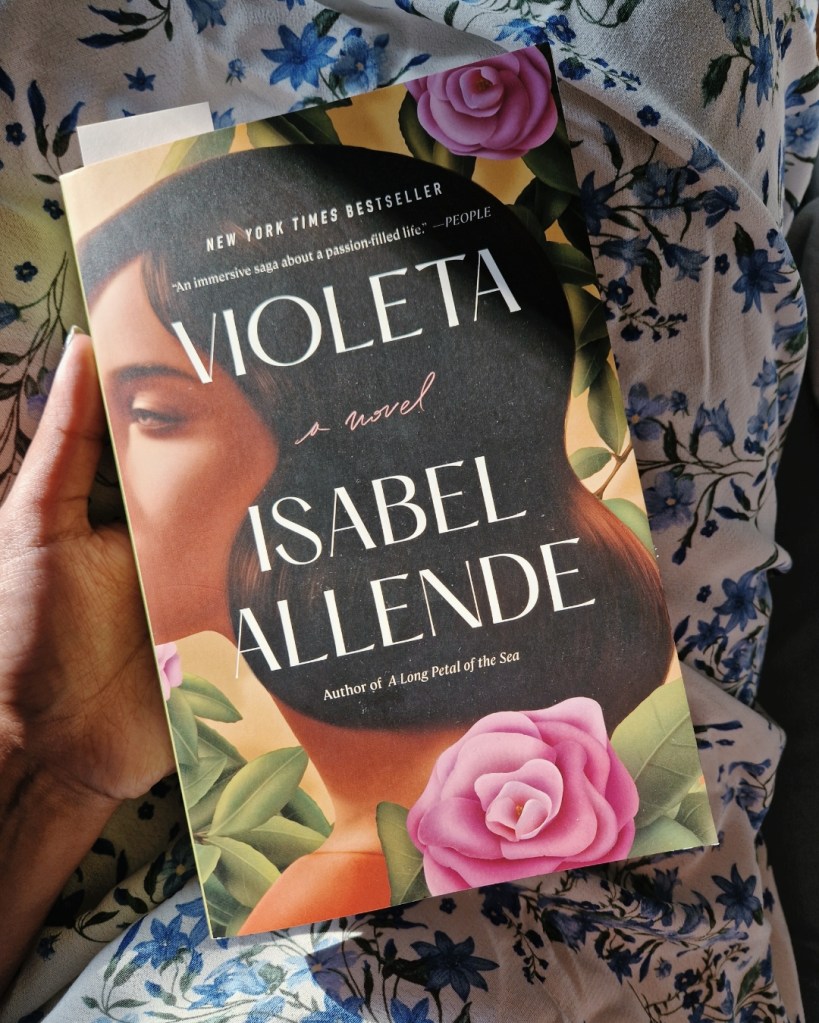
Allende has created an iconic female protagonist through Violeta. She is fearless in her femininity, which was rare but not alien in the mid-1900s. She only moves forward, the consequences of her actions often only an afterthought. Violeta is also flawed in ways that don’t feel fictional; within her and within her aunts, companions and children, you will see women you know or have known, and evolution of womanhood through generations will feel deeply personal.

Allende’s storytelling in Violeta in this century-spanning saga will engulf you with such grandeur that it will, quite literally, alter your brain chemistry, as they say these days. There is an elegance in her prose that makes the most mundane moments of Violeta’s life seem exhilarating; the fervour with which she lives every single day of her long life, awe-inspiring.

Allende also delves into the intense political complexities prevalent in South America at the time and the lives of common people in its aftermath, and in spite of the heaviness surrounding these topics, Allende is careful not to burden you too much or take the spotlight away from Violeta’s life.

While this book is perhaps not one for those uninterested in the chronological retelling of history, if you harbour any interest in reading about a diverse, nuanced range of characters that represent human nature exceptionally well, Violeta needs to find a place on your reading list. That’s about everything I will say for now.

Review: The Only Story

Julian Barnes’ latest novel (2018) is every bit a love story, but in more ways than one, not. In this very long story that spans decades, there is love lost and love gained, love given and love taken. There is filial love, romantic love, unrequited love and pure lust. And our narrator, Paul, reflects on all these kinds of love; all the myriad kinds of love he has experienced in his lifetime.

But as we fail to recognise initially, The Only Story is also about anger and about trauma, about anger as a result of trauma and trauma as a result of anger. It is about the various pitfalls of adulthood and the naivete of adolescence, and it is about loss, tangible and intangible. All of it, borne and witnessed by someone madly, deeply and irrevocably in love.

The Only Story opens with university first year Paul (19), visiting his family in suburban London over summer. His mother has signed him up for the local tennis clubs, in the hopes that her son might meet some beautiful ladies. Paul heads there reluctantly, and meet some ladies he does. Only it’s a lady, Susan (48), who is married with two adult offspring. At this point, the novel is all too predictable: Susan’s marriage is in shambles; Mr. Elephant Pants — as her husband is lovingly called – is a morbidly obese alcoholic and a fantastic villain. Paul is young and rebellious, and he is reveling in masculinity. Paul believes that beautiful Susan (who is also wise and nothing like the rest of her ‘played out generation’) needs to be rescued.

And so follows a relationship that is for the tabloids and village gossip. While Susan is never too vocal about the relationship, Paul is far from ashamed. In fact, he wishes his relationship was even more scandalous. Little does Paul know that he would be in it for a lifetime, and that the consequences of his first and only love are beyond his comprehension.

The Only Story, Julian Barnes © 2020

It doesn’t take a lot of intellect to realise Paul and Susan’s relationship will go downhill and eventually end. The real mystery lies in the when and the why. Why did Paul believe Susan needed rescuing? What happened when they ran away to London? When did Susan first resort to the whiskey? The answers are hard to find: Paul is somewhat of an open book and Susan remains an enigma throughout their tale. No one, friend or for, ever knew Susan. Consequently, there are either vague answers given by a man in love, or no answers at all. Paul frantically searches for explanations and answers as well, but time is precious when you are watching a loved one succumb to alcoholism and you are helpless.

As put by The Globe and Mail, the characters in the book end up nowhere (unless they die). But Barnes’ writes exceptionally, knitting an elaborate tale out of a relationship that doesn’t have a lot of substance to it. Paul, now half a decade later, draws endless conclusions about love and its exploits, which when listed out, seem overly pretentious. More often than not, I found myself saying, “No one asked for your two cents.”

However, amidst pages of long due realisations, there are two worth thinking about: first, “most love, even the most ardent and the most sincere, can, given the correct assault, curdle into a mixture of pity and anger”, and second, the lifelong power of prehistory on our relationships.

In the end, Barnes’ magnificent narration is what keeps the novel engaging, in spite of the lack of a significant plot twist or a dramatic cliffhanger. Perhaps, the cleverest device he uses is the shift of pronouns: Paul goes from “I” to “you” to “he” the farther he drifts from his relationship and the more estranged he gets from Susan. The anachronistic structure of the book, without emphasis on any specific event, is also intelligent, as it focuses on painting a larger picture of society and its perceptions of love.

I’d ask prospective readers to choose this book at their own risk: read it only if you are interested in the musings of a fifty something man as he looks back on his love story, his only story.

Review: A Man Called Ove

In 6th grade, my friend told me that “cute” wasn’t really an adjective, that anything could be cute without any meaning. But if someone asked me to describe A Man Called Ove in one word, I would, without question choose “cute”. It is nothing but heart-achingly cute.

Frederick Backman’s 2014 debutante was not an instant hit: nobody really wanted to read the story of a Swedish curmudgeon waiting on his death. The book only became popular by word-of-mouth; someone must have read it and told all his acquaintances, “You have to read this book! Ove is horrible but you’ll love him!”

A Man Called Ove, 2014

Ove (pronounced “Oove-eh”) is a despicable man doing despicable things in his neighbourhood — kicking cats, calling people names, barking orders and thinking everyone is complete idiot. Simply put, he hates everyone and everything. He’s never known anything beyond his principles and his routine. All of this grumpy and inflexible behaviour changes however, when a noisy family of four moves in next to him, and knocks on Ove’s door at every step of the way. Suddenly, Ove’s quiet

life turned upside down and he is doing things he’d always grumbled about. The matriarch-like figure in the house next door, Parvaneh, makes it her responsibility to thaw Ove’s heart the minute she meets him and the relationship that evolves is incredibly heartwarming.

Over 340 pages, Ove’s story beautifully unfolds, going back to a time when his life wasn’t as black and white as you’d initially make it out to be. There is longstanding sadness and frustration within him and beneath the many layers of anger, there is softness, warmth and a soft spoken man who was once in deep,deep love. How he got to his present state is a detail I will not indulge in. I must mention Ove’s relationship with his wife, because it will, undoubtedly restore your faith in the immense amount of love we’re all capable of, loyalty and strength, especially in times of adversity.

“Love is a strange thing. It takes you by surprise.”

A MAN called Ove

Backman writes with a tone of softness that is contagious. There is simplicity in his prose, making the book an emotional yet light read. He knows just when and how to pull at your heart strings and when you make you laugh. The balance between sadness and happiness in the book is almost perfect.

Although the book doesn’t take the reader through much of a journey, the journey here is Ove’s; it is his coming-of-age story, albeit at 59. All sorts of endearing, A Man Called Ove creates a soft spot in your heart and a filial bond with Ove. It’s one of those books you cannot predict anything about after having read only a few pages but it is also those books you cannot give up on. Once you get a glimpse into the gears inside Ove’s mind, you’ll want to see the book to the end.

A Man Called Ove is a book about love and loss, frustration and triumph, confusion and clarity and breaking and fixing — all of which leaves you a bit fuzzy and sad on the inside. Pick this book up if you want to fly and cry through unconventional and conventional love in the most unlikely of people and places.