
The chances of my knowing a science communicator who, like me, also had an international upbringing, studied life sciences at Jacobs University Bremen, collaborated with Olle Bergman, and lives and works in the UK were low, but never zero.
Meet Joanna Bagniewska, zoologist, prolific science communicator and author of popular science book, The Modern Bestiary, a compendium of curious animals that inhabit the earth.
Polish by birth, Joanna grew up all around the world – China, Italy, Thailand – often returning to Poland, before ending up at Jacobs University in 2003 for a Bachelor’s degree in Biology. But the study of teeny things in the lab never interested Joanna much; she found it difficult to relate to things she couldn’t see. Seeking more evolutionary, ecological and organismal biology in her curriculum, Joanna continued her journey around the world. She interned in Australia studying how roads affected wombats, wallabies and other wild animals, and spent a semester abroad at Rice University, Houston, working on Damaraland mole-rats. After graduating from Jacobs University, she found her way to the University of Oxford for her Master’s degree. The rest is history, as you will read below.
In our conversation, Joanna and I speak about the importance of precise and impactful communication when it comes to ecology and conversation, the life-changing power of science communication, and of course, our dear Olle.
Tell me a little bit about your journey into science communication.
The start of my science communication experience dates back to 2012. Three of my friends had organised a conference called Science: Polish Perspectives. The idea was to provide TED-style talks, but to a very high academic standard, in English, showcasing the work of Polish researchers in the UK and beyond. I applied to be a speaker at the conference, but I had massive imposter syndrome. I was talking about my doctorate, which was on the American mink; meanwhile, others were talking about blackholes and nanoparticles and AI – subjects that, to me, looked much more serious and appealing. Still, I went in, gave my talk, and it went so well that I got an invite to speak at a TEDx Warsaw event.
After the TEDx talk, a friend directed me towards FameLab, a science communication competition. I took part in the Polish edition of FameLab and won it. Suddenly, there were all these journalists getting in touch with me and the other finalists, asking to do interviews and to collaborate – it was very clear that scientists who can explain science to the public were a hot commodity. Thanks to these collaborations, I gained experience writing and editing popular science articles, creating quick one-liners for TV and radio, and conducting longer interviews. I’ve also done things like science stand-up comedy, science slams and Pint of Science.
At what point did science communication become a career choice?
In 2006, I came to Oxford for my master’s degree, and I stayed for my PhD. Immediately after my PhD, I got a job as a senior scientist at a startup that was looking at using bees to detect illegal substances. Really cool, but the startup eventually ran out of money, which wasn’t great. I began lecturing at Nottingham Trent University, and afterwards moved to Reading University.
That’s when the Brexit referendum happened. It was scary, because I only had my Polish citizenship, I was pregnant, and my contract was coming to an end – because that is the nature of academic contracts. I knew that, due to residency requirements, I had to return to work after my maternity leave. Still, there was no guarantee that my contract would be renewed, and jobs in zoology are not easy to come by. At this point, I needed to look at what my transferable skills were and what I could do outside of academia. I already had a significant chunk of science communication experience, so when Brexit happened, I built it into a career. For six years, I split my time between an academic job and a role in communications and public engagement; I have also been doing freelance science communication and coaching.
You’ve written a book, The Modern Bestiary, published in 2022. What inspired you to write the book?
You make it sound much more structured than what it really was! It was the beginning of 2021, and we’d had almost a year of lockdowns and the pandemic; the world was not in a good state and neither was I. At that point, I was approached by the publishers, Wildfire, who had an idea for a book about interesting animals that inhabit the earth, but needed someone to write it for them. The idea was great and after writing a few sample chapters to prove I could write, I got started on the project.
I have always wanted to write a book because I wanted to have a tangible legacy. Even though, as an academic, you produce scientific articles, they’re not read widely, unless you happen to be one of those select few to write a Nature paper. I wanted to do something wider-reaching than that.
Writing was such a refreshing, joyful experience. It was absolutely wonderful. My editor was so positive and helpful that at times I thought it was some sort of a hoax.
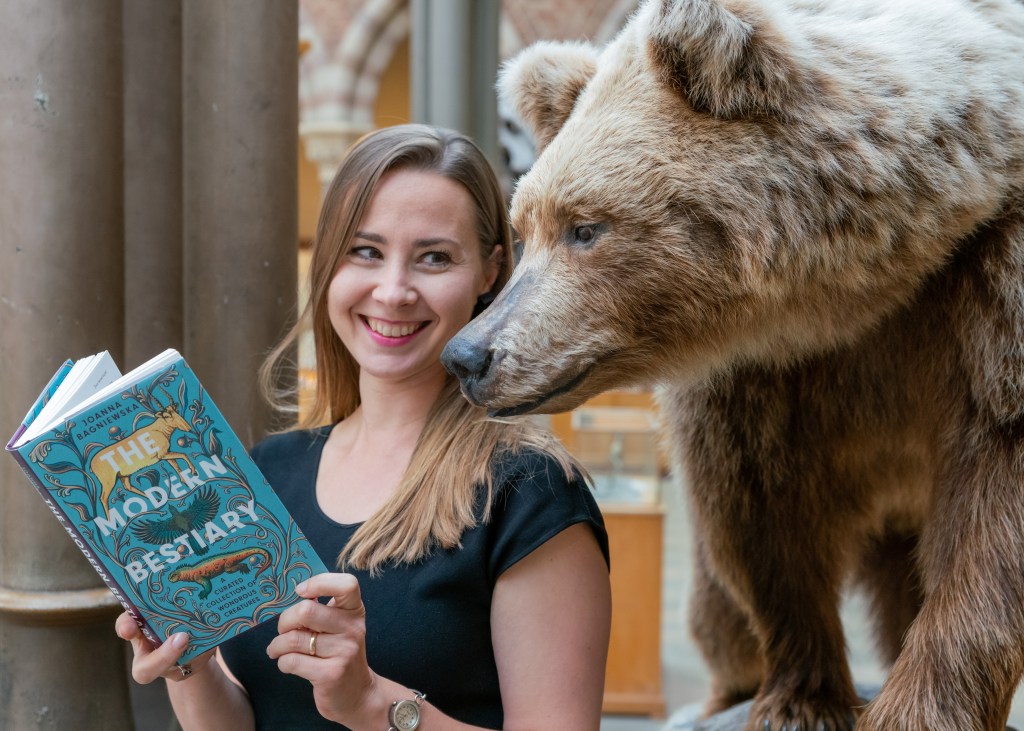
Photo credit: Greg Blatchford/yewneek.com
You’re currently the course co-director of the post-graduate certificate in ecological survey techniques at Oxford University. Why do you think it’s important to be a good science communicator in the field of ecology and conservation?
We’re in a biodiversity crisis and a climate catastrophe. At the same time, we’re living at a time when people are really pinched for attention and time; therefore, any message likely to break through needs to be formulated in a clear and precise way. All you can expect from an audience is a little bit of their time; you can’t expect them to untangle the information that you didn’t bother to present clearly. You have one shot to deliver a message, don’t waste it.
I think it is important to know strategies from communication, marketing, or advertising; they can be incredibly useful for changing behaviours, fundraising, raising awareness, lobbying the government and changing narratives. For instance, right now, UK institutions increasingly have sustainability or environmental policies built into their strategies. They’re looking at metrics such as the biodiversity net gain and similar. While a lot of these are not perfect, they’re a starting point. If you think back to ten years ago, this was definitely not very high on the agenda – clear and persistent messaging can impact action.
What role do you think your work is currently playing in that public behaviour change towards conservation?
It’s a multifaceted role. On one hand, my role is to shape the ecologists of the future, who will be the ones doing biodiversity assessments and gathering environmental data. If we are to see whether management has an impact on a site or on a species, we need to know the before and after. I’m teaching my students how to do that, so that they’re able to do their own projects and teach others.
On the other hand, in my science communication work, I try to inform the public about the natural world, what they can do in terms of participation in any citizen science project, and any little contributions they can make. People like to receive a message, but ideally with a call to action at the end. Anytime I have a radio interview or I write an article, I try to add that on.
“You have one shot to deliver a message, don’t waste it.”
You may have seen that people call the blobfish the ugliest animal to exist. As a zoologist, do you think any animal is ever ugly?
People are interested in superlatives – the ugliest or the slimiest or the biggest or the smallest or the prettiest. The blobfish is unlikely to win any beauty pageants, so we might as well go down the “it’s the ugliest animal on earth” route and fascinate people from that perspective.
My view of the beauty of an animal doesn’t reflect on its behaviour or how interesting it is. It also doesn’t have an impact on its conservation status. Still, it’s important for people to notice species.
A lot of research goes into how marketing strategies can be used to promote biodiversity; even the species name can feed into it. There have been studies on species with funny names or species that are named after celebrities, how that raises their profile and whether that then translates into conservation efforts. Whatever works, use the dirtiest marketing techniques you can – let’s just get funding for conservation because it’s such a woefully underfunded field. Call an animal “ugliest”, name it after whoever you want. If there’s money coming with it, go for it!
Conservationists have a concept of “flagship species”, something that’s big, or furry, or colourful, or impressive, or just with eyes that point forward and are cute; something like the panda, tiger, or orangutan. These species tend to gain the attention of the public; it’s easier to fundraise for tigers than for blobfish. Yet because many flagship species are great apes or large carnivores, they cover quite a lot of area in their territories. If you conserve the jaguar, you also conserve the tapir, which is grey and looks a bit like a pig and nobody really wants to donate money for that. Such wide-roaming species are called the umbrella species because if you support their conservation, you’re also conserving other animals that live on their territory.
Do you have a favourite animal? Why?
Oh goodness, that’s a difficult question. I find it difficult because there are so many interesting animals. I really love hedgehogs. I also have a soft spot for the Mary River turtle. It’s a turtle from Australia that is very endangered. It can breathe through cloaca while underwater, and is restricted to a very small patch of land in Australia. And I read somewhere that it would only take about £40,000 to protect the species. So, if you know somebody who’s really rich, who has 40 grand…
I will definitely let them know if I know someone.
You have another book coming out soon called The Communicating Scientist, written in collaboration with Olle Bergman and Jacobs University alumna Sarang Park. I wanted to digress to ask how it’s been working through the initial drafts of the book with Olle, but finishing it and approaching the publication date without him?
Writing this book was much tougher than my first one. I joined the project fairly late down the line. Olle reached out to me because he was stuck in this dark forest of editorial uncertainty and said, “Oh, would you be able to take a look at the draft? We can add you as a co-author, just please deal with this.” And I thought that a communications handbook for scientists is a really cool, useful idea. The book needed a pair of a fresh pair of eyes and I was glad that I could contribute chapters.
Olle was always the motor behind the project. The book was his baby. He would always come up with to-do lists and new documents and interviews with someone and getting bits and pieces. He was really committed to this project.
In December, two years ago, I was at a conference where I was running a workshop that Olle had developed the framework for. This turned out to be the day he passed. I found out two days later, and it was really, really tough.
I reached out to Sarang, and we told the editor what had happened. We were determined to complete the writing, and for Olle’s last book to have his name as lead author on it. It was a monumental effort because he had ideas in his head that we didn’t know about, so we had to fill in all these blanks and second-guess what he would have liked, but also use our own judgment, because we’re also authors.
When I was reviewing the manuscript, it was like having Olle read it out loud to me, which on one hand was lovely, but also difficult. He had left all these comments saying, “I’ll add that later”, or “I’ll check the reference to that later.”
It was incredibly difficult, but we managed to submit the manuscript and hopefully the book should come out next month.
What impact did Olle have on your science communication career?
I met Olle when my SciComm career was already quite well established. Still, he was a wonderful personality to have around – the perfect person to bounce ideas off, to ask questions and to learn from. I feel like we benefitted from each other’s interests and presence in a dimension much bigger than SciComm: he would ask me questions about Poland (he knew so much about it anyway), I would ask about the translation of Swedish literature; we shared a passion for history, languages, analysing how people think and what motivates them. The science communication aspect almost seemed like a side gig in this friendship!
Visit https://uk.bookshop.org/shop/Bookniewska to learn more about The Modern Bestiary and get yourself a copy! And pre-order your copy of The Communicating Scientist here, ahead of its worldwide release on 13 July 2025.
 Ushashi Basu