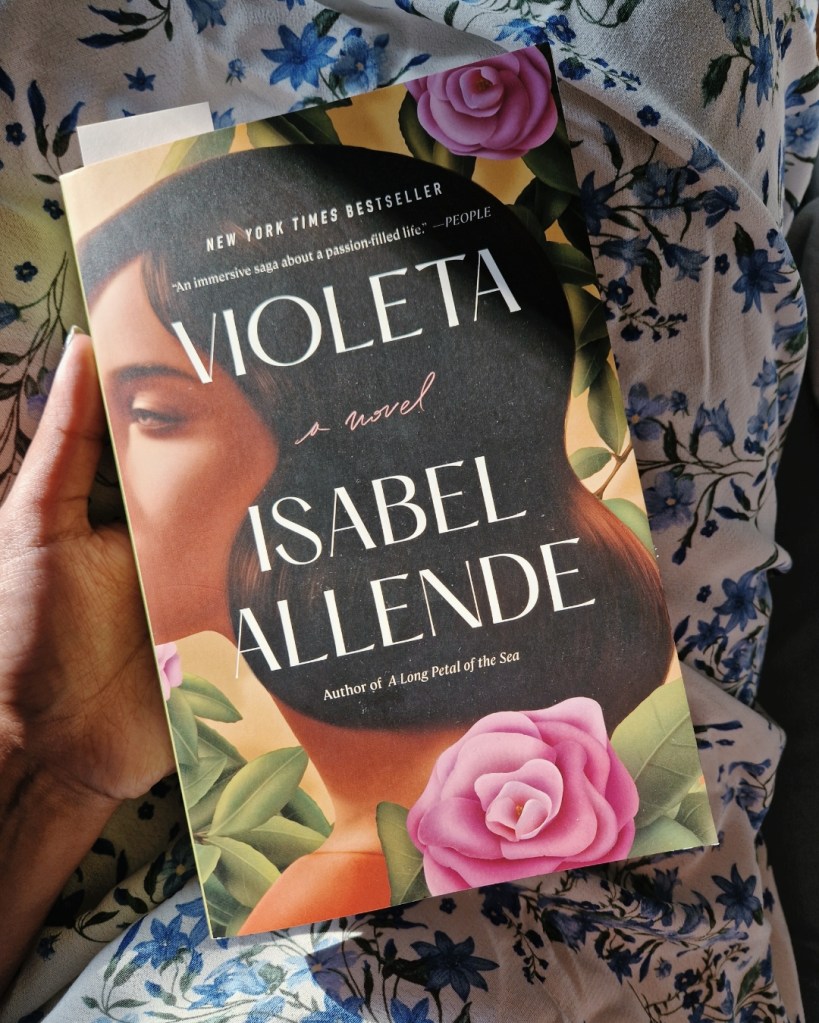
Earlier this year, I read A Long Petal of The Sea by Isabel Allende and I was convinced that it would be the best book I read this year and next year and the year after…you get it. But with Violeta, Allende has tested my choice and my taste and it is safe to say that I am stunned in every way possible by this breathtaking tale.
In this epistolary novel, Violeta recounts 100 years of her life to a man named Camilo (what his relationship is to Violeta is something I cannot give away). It is 1920, and Violeta is born in a South American country Allende has left unnamed. The world is recovering from The Great War and tackling the Spanish Flu in all its intensity. Amidst cautionary measures we are all too familiar with, Violeta begins developing into a vociferous and spoilt child, so much so that a governess from England is sent for. The Great Depression follows soon after and the devastation of this moment in world history sees Violeta’s family exiled to the far end of the continent, among vast, dry deserts and irrelevant villages.
Here Violeta is suddenly tamed and she flourishes, through many a trauma and triumph. When Violeta is in her twenties, a military coup ravages the country but she remains an apolitical observer to the destruction. A few more coups, a dictatorship, the Second World War and endless domestic turmoil, however, forces Violeta out of her oblivion. She watches loved ones come and go, and she experiences pain unknown to many of us. She enjoys passionate love – romantic and platonic. She forgives and forgets and regrets, but most importantly, she perseveres. And in the most poetic way, her life comes a full circle when, near death, she is trapped in her house because of the coronavirus and cannot truly say goodbye to the world that has been so kind yet so cruel to her.
Allende has created an iconic female protagonist through Violeta. She is fearless in her femininity, which was rare but not alien in the mid-1900s. She only moves forward, the consequences of her actions often only an afterthought. Violeta is also flawed in ways that don’t feel fictional; within her and within her aunts, companions and children, you will see women you know or have known, and evolution of womanhood through generations will feel deeply personal.
Allende’s storytelling in Violeta in this century-spanning saga will engulf you with such grandeur that it will, quite literally, alter your brain chemistry, as they say these days. There is an elegance in her prose that makes the most mundane moments of Violeta’s life seem exhilarating; the fervour with which she lives every single day of her long life, awe-inspiring.
Allende also delves into the intense political complexities prevalent in South America at the time and the lives of common people in its aftermath, and in spite of the heaviness surrounding these topics, Allende is careful not to burden you too much or take the spotlight away from Violeta’s life.
While this book is perhaps not one for those uninterested in the chronological retelling of history, if you harbour any interest in reading about a diverse, nuanced range of characters that represent human nature exceptionally well, Violeta needs to find a place on your reading list. That’s about everything I will say for now.
I systematically avoid reading self-help books, or any book that promises to dramatically change my life on the cover. This is not to say that self-help books haven’t ever worked for anyone, or that they are all entirely baseless — they’re just not for me. I struggle with the authority these books tend to establish and as I walk past the self-help section in a bookstore, I cannot help but ask, “why should I listen to you?” or “what is the truly groundbreaking advice you have to offer, that my mother hasn’t shared with me in the past 25 years?”
For many years, that is what I thought about Atomic Habits and I refused to even read its blurb, in spite of recommendations from people I trust with book recommendations. But one life-changing event and plenty of time on my hands to suddenly focus on myself, Atomic Habits landed impulsively on my nightstand. And while I determined that I had nothing to lose at the time, I find myself on this public forum today, ashamed to declare that I actually enjoyed the book.
James Clear, blogger (now author) and former baseball player, has compiled an easy-to-follow manual of how to implement new good habits into your life and maintain them to the point that they become an integral part of your very identity. He emphasises on consistency, patience and time throughout; Clear writes that consistently performing our habits and remaining patient about their outcomes has more power and impact than we give it credit for. These habits can be as miniscule as a grain of sand, and before you know it you’ll have a wonderful beach at your disposal (apologies for the cliche). That these habits are supposed to be good is a given. Clear leaves it up to you to decide what is a good habit for you and conversely, what will end up being a bad habit in your life.
Clear has laid out a very clear plan for you to develop good habits and hold yourself accountable when you catch yourself slipping. Make sure the cue for you to perform the activity is obvious and attractive, and the activity itself is easy to do. The actual habit should also be satisfying to engage in. Finally, reward yourself with something attractive after you’re done. “Easier said than done,” my brain grumbles, while also making me stick page markers to make note of the process because who knows, it might just work.
What stands out amidst all the graphs and tables and doodles though, is Clear’s humility. He doesn’t claim that his methods are foolproof and he doesn’t diminish the quality of your current life. He does not appoint himself as your life-coach either. His approach is simple – if by chance, you would like to improve a few aspects of your identity, here’s how to do it, remember to start small and not give up at the first obstacle. Based on this brief character analysis, I don’t think one would be bored and vexed out of their minds if they were to meet Clear for a cup of coffee.
However, the book does lose momentum a little more than halfway through, and in repeating himself to exhaustion by the end of the book, Clear has made sure I never pick up a self-help book after Atomic Habits. But repetition warrants routine; if you repeat a good (or bad) habit enough times, it will, undoubtedly become a natural part of your day-to-day. One could say that this narrative technique is nothing but Clear’s subtle strategy to stress on the power of repetition.
It also goes without saying that Clear fails to consider cultural and socio-economic nuances in his formula: reinventing your life by writing down your habits and scoring them based on their worth in your life — one of the methods Clear suggests — is often a distant fantasy and a privileged way of living, when you have very little choice in deciding what is good and what is bad for yourself. You are selfish. A topic to deliberate on another time.
Everything said, the converse of what I stated when started this review with is also true: who am I to challenge these so-called experts and review their hard work on my insignificant blog? I have not cracked the code to good living and I am definitely not a world class athlete. But I like this vantage point and I like the mediocrity. I think I’ll keep some of my bad habits.
So I don’t know how far I am willing to go to implement any of Clear’s methodologies in my life (I can report back in a year), or if I will remember any of this in a few months’ time. If I find myself at an impasse, my wise mother is only a phone call away and Atomic Habits will become a mere breezy summer read.
I read very few books in 2022, disappointingly, and wrote about even less. In retrospect however, I felt like I had a lot to say about some of these books and share them with whoever reads my little blog.
In a first, I’ve combined three reviews in one post, but fear not, they’re short and hopefully a fun read. Why, you ask, am I writing about books I read last year, in February of the new year? I procrastinated, that’s all.
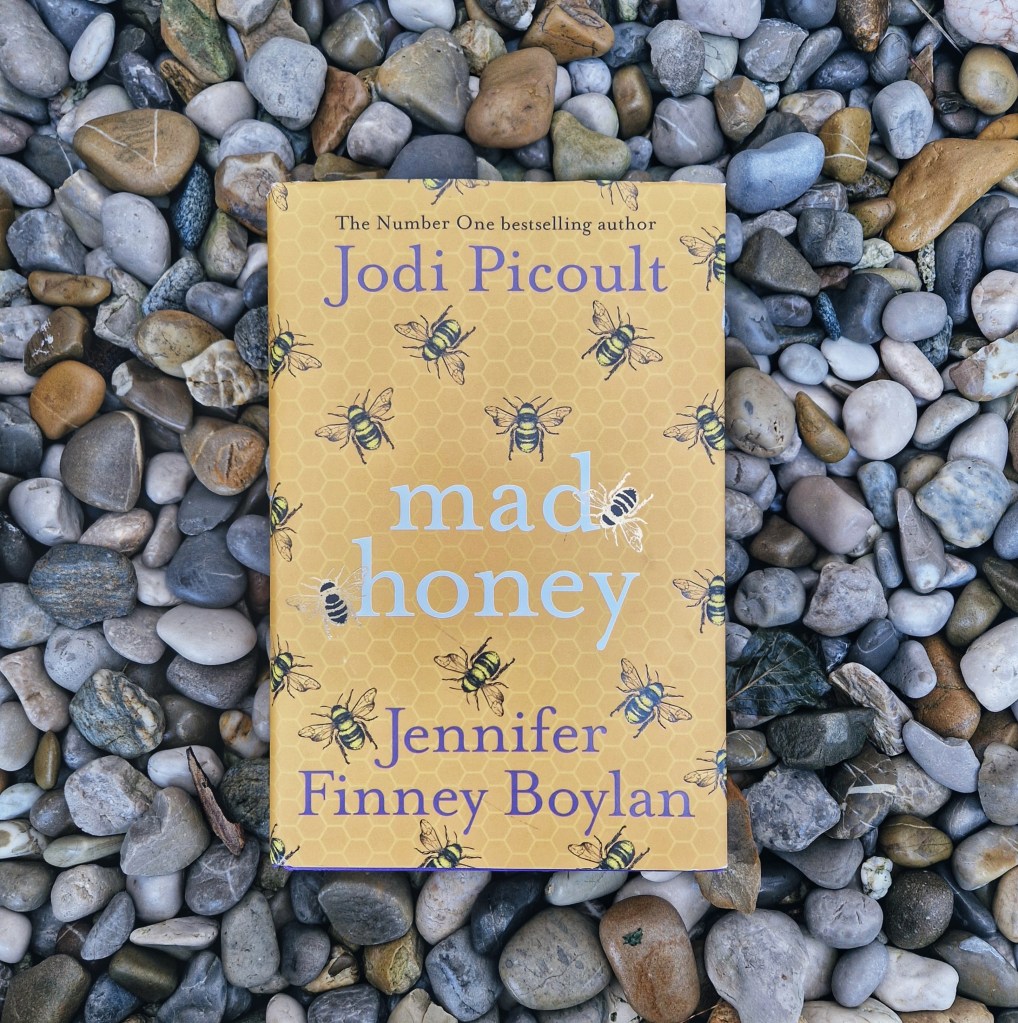
Mad Honey – Jodi Picoult and Jennifer Finney Boylan
I didn’t know what sort of reading experience I wanted out of Mad Honey. Jodi Picoult’s last two novels, Wish You Were Here and The Book of Two Ways weren’t memorable to say the least, so naturally, I was expecting nothing and everything from Mad Honey. And my, oh my, did it take my breath away.
Picoult and Jennifer Finney Boylan joined forces for Mad Honey in the most bizarre way – via their Twitter DMs – and gave new depth to what means to be a woman in the 21st Century and the distances we go and the risks we take to protect our secrets.
Lily Campanello is dead (this is not a spoiler) and her too-good-to-be-true boyfriend, Asher Fields has been arrested for her murder. Asher is also the glue that holds his mother, Olivia’s peace and sanity together, and his trial is also Olivia’s trial – and everything she’s ever held dear about her son.
Olivia, written by Picoult, narrates the story forwards, from the day Lily is found dead, through Asher’s court battle and what comes after. Lily, written by Boylan, narrates backward, from the moment she (unknowingly) looks into the eyes of her murderer, through the tender moments she shared with Asher when they first started going out and the life she had before she and her mother Ava moved to Adams, New Hampshire, in the hopes of leaving behind all their scars and brokenness in California.
Between these timelines, a lot is said and misunderstood, and unsaid and understood.
The ending is haunting; the feeling of the sudden uncertainty that upends Asher and Olivia’s life, the knowledge that a kind, effervescent and emotional soul such as Lily’s will never tread the earth again, and that Asher and Lily will never get to live out their relationship on their own terms – all of it settles into you as you turn over the final page and firmly shut the book, because that’s the only way to keep Lily alive.
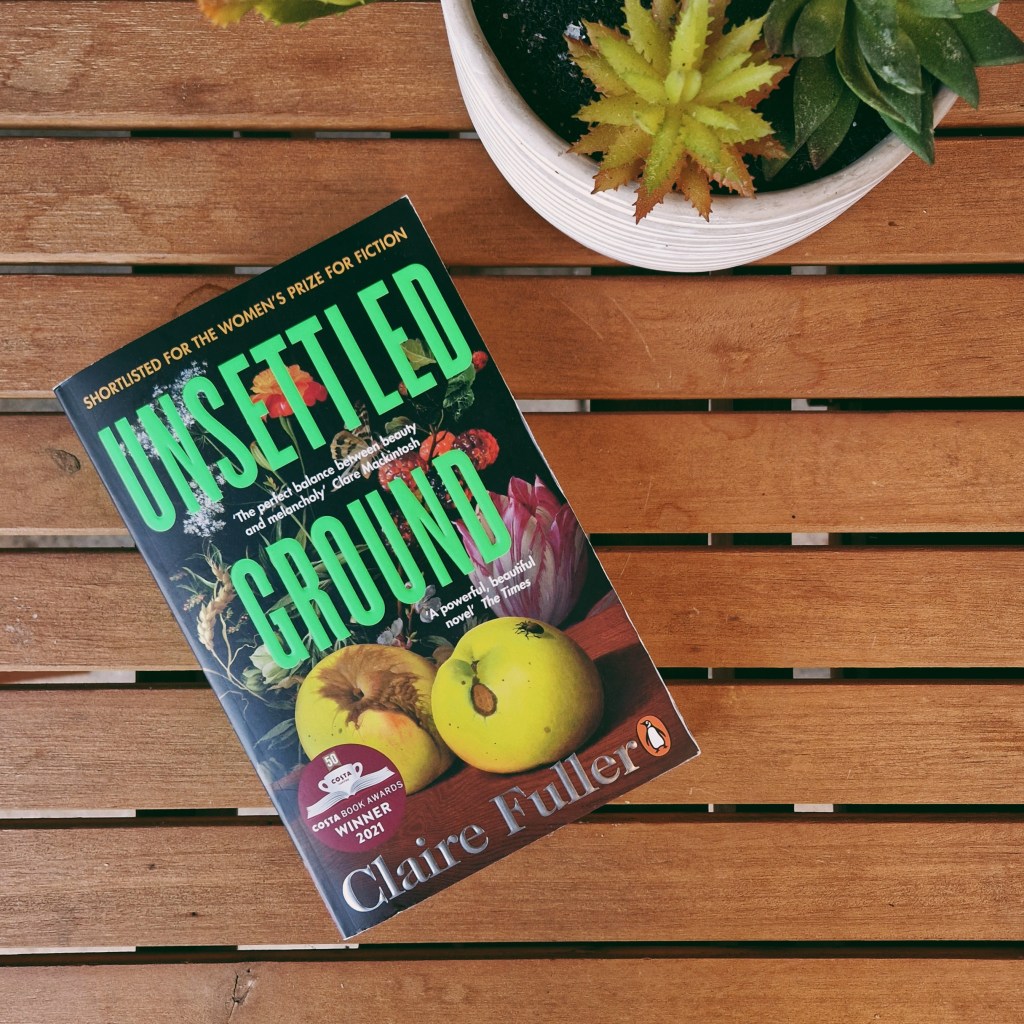
Unsettled Ground – Claire Fuller
When I bought Unsettled Ground from an extremely cosy independent bookshop in my neighbourhood, I did it because I adored its cover art. There was something eerie and inviting about the floral pattern against the black backdrop, like there was something awful scampering around beneath the flowers – and never have I ever read a book that captures its essence so accurately on the cover.
Twins Julius and Jeanie are in their mid-fifties and have never lived on their own, away from the humble cottage they were born in. Their mother, Dot, has shielded them from just about everything their entire lives, on the edge of the world where no man has ventured for a very long time. But when Dot dies without a sound one morning, Julius and Jeanie find themselves exposed to threats they never knew existed and unable to navigate the curveballs that come their way.
Unsettled Ground is a quiet novel that unravels more and more darkness as you make progress, much like the twins themselves. Literally and metaphorically, Julius and Jeanie go about their lives silently, doing what they’ve been taught to do and nothing more, except for when they sing together and momentarily set aside their suffering and shortcomings. Technology fails them, and bureaucracy makes no sense. Underneath the surface however, they harbour secrets that could destroy everything that holds them together.
Fuller writes delicately but with great impact. In the beginning, I felt infuriated at Julius and Jeanie’s incapacity to accept and adapt to the world outside their farm but with each new secret that sheds more light on why the twins were afraid of what the modern century had to offer, I sympathised with them a little more. We truly do not understand what every day would be like without the most basic appliance or the inability to communicate within seconds – and Fuller leverages this lack of understanding to display just how complicated our relationship with the natural world and our own instincts have become.
Fuller peels back the toughest layers of each character as they try to steer their way through the obstacles that litter their path, and shows that in the face of every gruesome and unfair thing that happens to us, our compassion for one another is what matters the most.
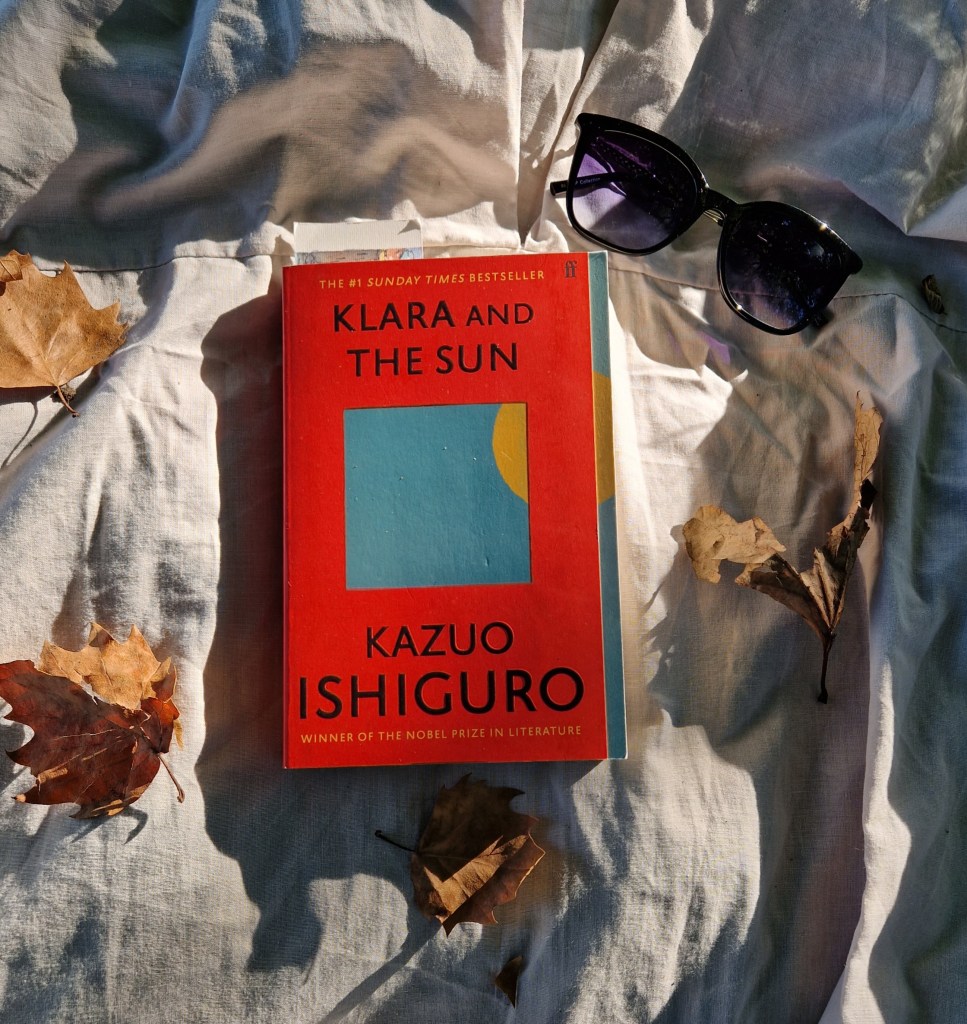
Klara and the Sun – Kazou Ishiguro
Klara and the Sun was on my to-read list for longer than I can remember, and the wait for the paperback version was long and painful (the hardcover book was too expensive, sorry!). And in all honesty, I’m not entirely sure it was worth it – controversial take, I know.
In a utopian world, Klara is an artificial friend (AF) and she’s chosen by a young girl named Josie who happens to be terminally ill and is in need of a friend-turned-carer. Klara accompanies Josie and her mother to their bungalow outside of town and prepares for a life of being everything Josie needs. Over time, Klara unearths family secrets and learns about human nature – our wasteful habits, how we make promises we don’t keep, how we often pretend to be something we’re not, and the lengths we go for those we love. Klara serves her purpose to the best of her ability, often attempting highly dangerous tasks to ensure Josie’s health and well-being. And then we move on.
Any and all questions you might have as you read Klara and the Sun, Ishiguro doesn’t answer. What does an AF look like? What illness afflicts Josie? What does it mean to be lifted? Is Josie a genetically designed child? And most importantly, how did we get here?
While the lack of context for the setting of Ishiguro’s latest novel is rather frustrating, through Klara, he has done what he does best: build a protagonist that wields great power and draws you into their world, unlike any other character.
Klara is calm, empathetic and fiercely loyal. She thinks deeply and tries to make sense of everything around her, even when it doesn’t make any sense. Her acumen as artificial intelligence doesn’t shroud her compassion or her sensibility. As she narrates the story of how she met, acquainted with and loved Josie, we see an unbiased and unique view of the world.
By the end, although I had about a thousand burning questions and was truly itching for answers (everyone will), I knew I wasn’t going to get any because that was not the point. In experiencing our broken ways of life and our fatal flaws through Klara’s cohesive and clear thoughts, Ishiguro has created a bold, intricate yet realistic map of where we’re inevitably headed.
Julian Barnes’ latest novel (2018) is every bit a love story, but in more ways than one, not. In this very long story that spans decades, there is love lost and love gained, love given and love taken. There is filial love, romantic love, unrequited love and pure lust. And our narrator, Paul, reflects on all these kinds of love; all the myriad kinds of love he has experienced in his lifetime.
But as we fail to recognise initially, The Only Story is also about anger and about trauma, about anger as a result of trauma and trauma as a result of anger. It is about the various pitfalls of adulthood and the naivete of adolescence, and it is about loss, tangible and intangible. All of it, borne and witnessed by someone madly, deeply and irrevocably in love.
The Only Story opens with university first year Paul (19), visiting his family in suburban London over summer. His mother has signed him up for the local tennis clubs, in the hopes that her son might meet some beautiful ladies. Paul heads there reluctantly, and meet some ladies he does. Only it’s a lady, Susan (48), who is married with two adult offspring. At this point, the novel is all too predictable: Susan’s marriage is in shambles; Mr. Elephant Pants — as her husband is lovingly called – is a morbidly obese alcoholic and a fantastic villain. Paul is young and rebellious, and he is reveling in masculinity. Paul believes that beautiful Susan (who is also wise and nothing like the rest of her ‘played out generation’) needs to be rescued.
And so follows a relationship that is for the tabloids and village gossip. While Susan is never too vocal about the relationship, Paul is far from ashamed. In fact, he wishes his relationship was even more scandalous. Little does Paul know that he would be in it for a lifetime, and that the consequences of his first and only love are beyond his comprehension.
It doesn’t take a lot of intellect to realise Paul and Susan’s relationship will go downhill and eventually end. The real mystery lies in the when and the why. Why did Paul believe Susan needed rescuing? What happened when they ran away to London? When did Susan first resort to the whiskey? The answers are hard to find: Paul is somewhat of an open book and Susan remains an enigma throughout their tale. No one, friend or for, ever knew Susan. Consequently, there are either vague answers given by a man in love, or no answers at all. Paul frantically searches for explanations and answers as well, but time is precious when you are watching a loved one succumb to alcoholism and you are helpless.
As put by The Globe and Mail, the characters in the book end up nowhere (unless they die). But Barnes’ writes exceptionally, knitting an elaborate tale out of a relationship that doesn’t have a lot of substance to it. Paul, now half a decade later, draws endless conclusions about love and its exploits, which when listed out, seem overly pretentious. More often than not, I found myself saying, “No one asked for your two cents.”
However, amidst pages of long due realisations, there are two worth thinking about: first, “most love, even the most ardent and the most sincere, can, given the correct assault, curdle into a mixture of pity and anger”, and second, the lifelong power of prehistory on our relationships.
In the end, Barnes’ magnificent narration is what keeps the novel engaging, in spite of the lack of a significant plot twist or a dramatic cliffhanger. Perhaps, the cleverest device he uses is the shift of pronouns: Paul goes from “I” to “you” to “he” the farther he drifts from his relationship and the more estranged he gets from Susan. The anachronistic structure of the book, without emphasis on any specific event, is also intelligent, as it focuses on painting a larger picture of society and its perceptions of love.
I’d ask prospective readers to choose this book at their own risk: read it only if you are interested in the musings of a fifty something man as he looks back on his love story, his only story.
The idea to write a piece on the interconnection between dreams and creativity came to me in a dream. I’ve dreamt entire plots of great thriller novels and even their sequels. But this is not just me, and this is just the tip of the iceberg.
Dreaming is a process that occurs voluntarily in the mind, mostly during specific times of sleep. It can be described as a collection of clips, images, feelings and memories – both good and bad. The intensity and the contents of dreams change throughout the sleep cycle, with the most significant of them occurring during REM – Rapid Eye Movement – phase of the sleep. Brain activity is highest during this phase (as measured by encephalograms), which could explain the vividness in dreaming. While dreaming, the brain connects events that have occurred throughout the day, thereby weaving narratives.
Creativity, on the other hand, is one of the human mind’s most inexplicable qualities. It has historically been extremely difficult to determine what creativity stems from. A friend, who studies psychology told me that creativity is a bit of a can of worms in psychology. Creativity is known to create new connections between different brain regions, but only recently have neuroscientists, through fMRI’s, PET Scans and other scanning technologies, been able to study creativity more closely.
Quite unsurprisingly, dreaming and creativity are closely intertwined with each other, so much so that it is almost impossible to study one without the other. Because the brain stitches stories about everything and everyone we encounter, it could lead to the birth of novel ideas, and developing on this idea could quite possibly help sharpen our creativity (even for those who are always whining about how they’re not creative…at all). Dreams have proven to be inspirational – affecting the whole world kind of inspirational – multiple times in the past; in 1818, Mary Shelley dreamt of a scientist who created life and went on to write Frankenstein, one of the most influential science-fiction works of all time. Italian composer and violinist Giuseppe Tartini composed his most famous work “Devil’s Trill Sonata” after the devil played the tune to him by his bedside in a dream. During dreaming and during creative processes, dopamine level increases in the “pleasure centres” of the brain, and this acts as a positive feedback loop to keep dreams and ideas constantly flowing.
“Creativity is a bit of a can of worms in psychology!”
Ignacio Muñoz, research assistant and undergraduate student of Psychology, Jacobs University Bremen.
It is not entirely difficult then, especially for those already creatively inclined, to manifest their creative dreams and project them into prose, poetry and other forms of art. The product can, quite easily be superior to those produced during wakefulness, simply because of the enhanced brain activity.
But is it possible to use this aspect of dreaming in fostering creativity without actually sleeping? Perhaps.
In his book “Writing: A Memoir of The Craft”, Stephen King writes that in both activities, “we learn to be physically still at the same time we are encouraging our minds to unlock from the humdrum of rational thinking.” It is absolutely feasible to train our brain and our mind to silence itself during any time of the day and push it into a where the brain activity does not manifest as physical activity. Daydreaming for example, is one situation where our mind wanders and gives rise to sudden bursts of creative ideas.
Another way to embody creative dreams is dream recall. As unbelievable as it might be (from experience), it is possible to completely recall all our dreams and then, note it down. A key factor that influences our ability to recall dreams is the speed at which we fall asleep and at which we wake up. The longer the state of our hypnagogia – a state of half wakefulness and half sleep – especially when we are waking up, the better our memory of the dream. And if the dream is ingrained in the brain as a memory, it could be used a ‘plot’ for another dream, and the cycle goes on. Relaxing into bed and gradually letting our body take control, hence, could have drastic effects on our creativity. The only people who have very minimal dream recall ability are usually clinically depressed, according to studies, but that is a different aspect of discussion altogether.
Either way, writing books or a plot for a movie based on a dream is not only achievable, but also encouraged. All of our crazy, erratic dreams could be our brain trying to tell us a story, a story that holds the potential to become a great work of art. At the least, it could push each and every one of us to create without any kind of inhibition. We need as much art as possible in the world – philosopher and novelist Iris Murdoch believed that good art is a vehicle of truth – and so, maybe it would be wise to harvest anything that allows more art to be created.
Now if you’ll excuse me, I’ll go and finish the three part dystopian tale I’ve been dreaming of for years.



 Ushashi Basu