
Almost every third Wednesday of the month, a group of people gather in a room on the first floor of a lively pub in London, pints in hand and an order of scampi and chips on the way from the kitchen. Everyone is buzzing and scrambling to secure the best seats in the house (I, too, am guilty of this). Their purpose there? To spend the evening learning, understanding and engaging with science. There is an equally, if not more, eager speaker at the front of the room, thrilled to share their work with people who will listen in awe.
This is Pub Sci, or more formally known as Science in the Pub. Science, in a place you’re least likely to find it. And the helm of this event is the enigmatic Richard Marshall.
For approximately five minutes at the start of the event, Richard will tell you all about PubSci, plug PubSci’s many social media channels, introduce the speaker and then sit back and let the science communication commence. A skilled science communicator himself, for those two hours at PubSci, he only serves as a medium, bringing science to the people.
I invited Richard to a tête-à-tête to learn more about him and how he makes PubSci happen. Over a double macchiato at the Science Gallery Café a few weeks ago, Richard gave me a glimpse into the PubSci backstage, how he came to run the event and why good science communication is important.
Before we get into all things PubSci, tell me a little bit about yourself, how you started out in science communication.
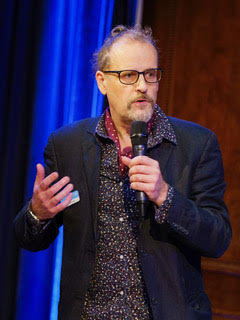
I took a very circuitous route into science communication. I studied engineering, sort of an interdisciplinary engineering, which had very little design aspect. The bit that I enjoyed most really was all the ancillary stuff. Planning, public speaking and giving presentations. I nearly switched to a language degree and then also thought about doing theatre. But I stuck with it and I worked for a company called Schlumberger in Germany, both in my industrial placement and then back in the UK after university. But I had itchy feet – I felt that I wasn’t fulfilled with what I was doing, so I went and started working in tourism. And then after a while, I got frustrated with that as well, because I wasn’t using my brain sufficiently. I also felt slightly uncomfortable about the tourism industry in general because you’re taking people to beautiful, unspoiled places and then essentially either gawking at them or spoiling them. Then I went travelling for a while to Central America, learnt Spanish and had some wonderful experiences. After that, I started attending various classes at The City Lit and Morley College, trying to understand what it is to be a viewer. Oh! And I missed the part where I studied photojournalism at what is now the University of Arts London (UAL).
So, let me get the chronology right: engineering, work placement, tourism, travelling, photojournalism?
Yeah. You know, I have an eclectic mind that’s interested in a lot of things. And I wanted to satisfy quite a lot of it while I was still relatively young. So, as I’ve mentioned, I studied anthropology and attended various classes to understand what it is to be a viewer, to be a photographer, whether you can ever have an outsider perspective as an insider and vice versa. And I also discovered some wonderful courses on physics and philosophy.
How did you get back into STEM and Science Communication after the digression into tourism, travelling and photojournalism?
My return to STEM began when I was invited to give a series of guest lectures at London South Bank University for a BEng and MEng module that serves the same “soft skills” role as the topics I’d enjoyed most in my university days. Ethics, Critical Thinking and Project Planning are three things I’m rather passionate about and had done some work on previously, so it was easy for me to adopt them for Engineering students.
The lectures were well received by faculty and students and, when a key staff member retired, I was asked to run the whole module. So I became a university lecturer and module leader, which was my first taste of formal teaching. I really enjoyed it, and the students excelled in their exams. When another staff member retired, I started running tutorials and labs, teaching technical subjects that took me back to the basics of Engineering maths, mechanics and electronics – a skillset I’d largely put aside in my years of tourism, photography, and non-science event work. And so I got my STEM mojo back!
I enjoyed lecturing for several years until – as for many people – the COVID pandemic gave me an opportunity to reflect. I emerged from lockdown no longer a lecturer but a science communicator and event manager, which I continue to this day. I absolutely love it; for example, I get to spend several days a month doing science shows and workshops with primary school kids, watching their faces light up with wonder at a new fact or an exciting experiment.
It’s really important to plant the seed of wonder early. They will have plenty of time to learn that bench science is often slow, repetitive and frustrating – but it’s the seed of wonder that keeps us going in a career when things get tough. It’s easy to engage the kind of kids you’d expect to have career in science – they always make themselves known in a workshop, and that’s great – but it’s even more important that we engage the arty ones, the sporty ones, and especially the ones whose home life hasn’t encouraged them to dream about their futures.
How and where did PubSci originate, and how did you come to run it?
PubSci was started in 2011 by Paolo Viscardi and James Robson. It started as an event that involved putting on science talks that they would want to go to themselves. At the time, Paolo was a museum curator, and James was working with live animals. It started off as just a thing that some friends do.
I think I went to the very first one because it was very near where I lived in Brixton. And eventually, I got really involved and became good friends with Paolo. When Paolo got a job that required him to move to Ireland in 2016, there was a risk that PubSci wouldn’t carry on. At this point, I’d already been asked to host a couple of the PubSci Christmas quizzes, and I realised I enjoyed hosting events. After Paolo left, it fell on about five or six of us to take turns running PubSci. But we were various people with different time commitments and some people moved away. Eventually, it kind of fell on just me to decide whether I wanted to run this myself or let it go.
So, from around 2018, I started hosting, programming, planning and marketing PubSci myself, as a kind of one-man band. In 2020, we went online for a little bit because of the pandemic, and it took me a while to restart the event in person. I restarted it in 2023, I think, when I had the brain space to start it again.
But I must mention, I’m not the owner of PubSci; I think of myself more as the current steward of PubSci. Whilst I do all of the above, it couldn’t have happened without the community. Friends, regulars and volunteers help to set up chairs before the event and return the room to its original state afterwards. Because PubSci doesn’t charge entry, but invites contributions, everybody who comes along is invested and involved in some way, making the audience very much a part of PubSci. Regular attendees will know Mike Lucibella, for example, he’s the first face they see on arrival. Mike is a science communicator himself and got involved with PubSci before the 2023 restart. It’s really important to have friends you can bounce ideas off, and we often meet to discuss things over a pint. Behind the scenes, there’s an unofficial ‘committee’ (more a family) of dedicated folk who’ve been involved since the early days (including the mother of one of the founders!) who help to keep an eye on things.
What role do you think PubSci plays in public engagement with science? What does it do for the people?
There are several simultaneous views of science. There’s the priesthood of science, for example. And then there’s also the sort of mad scientist; if you think about it, a lot of disaster films begin with the hubris of scientists doing something that they shouldn’t. So popular culture gives us a lot of different ideas of science and I think actually allowing people to meet scientists and ask them questions is really important. Scientists shouldn’t be considered a different species, you know?
And of course, it’s absolutely brilliant to go to a big theatre and ask a scientist a question. But to be in a pub with them, and to be able to engage with them directly, see the whites of their eyes – I think that’s really important for trust.
One of my aims with PubSci, one of the things I always say when people ask me to describe it, is that I am trying to take science communication out of the lecture theatres and academic spaces, and bring it to where the people are. Bring something to people rather than bringing people to the thing, which totally changes the context.
And people are in the pub…well, not everybody. I don’t want anyone to feel excluded – they have soft drinks there too.
A sense of inclusion and involvement is very much my vision for science communication and outreach, because we’ve seen how talking down to the public doesn’t engage people in science and scientific literacy. We see the effects of anti-science around the world, not least the USA, where it’s been politicised and weaponised by making anti-science narratives something that people get emotionally invested in. My dream is for the general public to become emotionally invested in scientific literacy, as well as intellectually invested, and I see PubSci as playing a small role in that.
Coming to Science in the Pub shouldn’t be a lesser experience than going to the pub with your mates or watching football or a band or a play – it should leave us feeling just as connected and fulfilled. That’s my goal.
“I am trying to take science communication out of the lecture theatres and academic spaces, and bring it to where the people are.”
Do you ever think about expanding PubSci – more locations, bigger events?
I want it to be small and intimate. I don’t want PubSci to be a stadium-size event, you know? That trust between the audience and the speaker and the organiser kind of depends on the fact that anybody can come and have a chat at the end. If it gets too big, that doesn’t really work; then it becomes a show and I don’t want it to be a show. So, I mean, I think my aim is rather than increasing the size, is to just keep improving the quality. To me, that’s far more important. And if people sort of like the idea and want to start something called…you know, Science in the Cafe or something, that’s great. It would be a full circle moment, from when I was involved with Café Philosophique and Café Scientifique in the 90s, both inspired by the old Parisian Left Bank discussion cafés. “Café Sci” was something of a model for PubSci and has a worldwide presence.
What are some of your hobbies, outside of facilitating events like PubSci?
Talking about science is actually a hobby. I did a one-man narrative comedy science communication show last year, and I’m now working on another one. Although it’s a fairly self-selecting audience, it’s about bringing science out of lecture theatres and into places where people are going to learn and hear and laugh. So, the science comedy, I suppose, is a hobby; I don’t do it enough to call it a profession…yet.
Along with PubSci, I do some sort of freelance events, hosting and producing. I’ve also started to realise that I’ve done quite a lot of facilitation. It’s one of those things where I’ve realised I’ve been doing it, but I’ve never given a name to it. I recently completed a five-week course facilitation course to formalise and put a name to the skillset I’ve built up over the years and root it in the context of science. Because you know, with facilitation, there are so many contexts where it’s really important, like community engagement or in co-creation, it’s not something that you can just do without thinking about what the processes and methods are and whatever.
Everybody who’s ever known me since I was at primary school knows that you can’t stop me talking about science. And even though I’m not a scientist, I always have to make this clear, I’m not a scientist, I’ve never been a research scientist. I have an understanding, I know how to read a paper, but that doesn’t mean that I’ve sat there and struggled with my data and published a paper. And I will never pretend that I have. But what I do have is the ability to create a narrative. And that’s really, really important.
I also write short stories with scientific themes, some of which can be found online at https://lablit.com/. I’ve also written science pages for The Lost Doctor, an unofficial Doctor Who Annual, presenting quantum paradoxes in a way that children would understand and adults can enjoy.
What other hobbies…so two ends of the spectrum. Formula One. I’ve been watching with a bunch of my friends for nearly 20 years. Although we’re distributed around the country and around the world now, we try to get together with food and drink to watch the races whenever we can.
The other one is Morris Dancing. And writing, singing and playing folk music as well.
What is Morris Dancing?!
It’s traditional English folk dancing. I dance with Brixton Tatterjack Morris. It’s a great physical exercise actually; it involves a lot of jumping around and banging sticks and shouting.
And finally, as is customary to ask, do you have a favourite PubSci memory?
That’s a great question; it’s one I should have anticipated, having studied journalism myself a long time ago.
It’s hard to pick just one [memory], but top of my mind is Eugenia Cheng’s talk in June 2023 called ‘Is Maths Real’. Eugenia is a brilliant writer and speaker based in the US, whom I happened to meet at the Royal Institution when she was over to talk about her previous book. I hadn’t yet restarted PubSci after the pandemic and was scheduling the first season of speakers when we met. As soon as I explained what PubSci was about, Eugenia was invested – she’s Scientist in Residence at the School of the Art Institute of Chicago and her passion is communicating maths to non-mathematicians – so she put me in touch with her publisher to arrange it.
We had a very full house that evening. What was remarkable for me was how many people said they’d always been afraid of maths but had chosen to come to that talk. Eugenia made her topic so graspable and meaningful that a few audience members were actually moved to tears from the relief of finally understanding something after years of feeling stupid. They’d been told at school that maths just wasn’t for them and had lived with a sense of shame and failure until Eugenia was able to demonstrate that maths is actually for everyone, including them.
That is the power of good science/STEM communication. It can make us laugh or cry, or gasp or say “Wow!” It can – and I think should – leave us with the feeling that we’ve learnt something which helps us to see the world in a slightly different way.
For more information on upcoming PubSci events, visit https://linktr.ee/pubsci.
 Ushashi Basu